When the Gaze Returns to the Viewer: Identity, Symbols, and the Mutual Gaze in Tian Hang’s Painting
When the zebras in the foreground and the tiger enclosed within a gilded frame simultaneously direct their gaze beyond the painting, who is really looking at whom?
In Mutual Gaze, Tian Hang first establishes an apparently clear spatial relationship: the zebras stand outside the frame, while the tiger is placed within a gilded frame depicted inside the composition. This spatial division, however, does not produce a stable order of looking. The zebras in the foreground face almost directly outward, while the tiger’s gaze appears to cross the frame and move between the zebras and the viewer. In the upper-right corner, a bird observes the scene from yet another angle.
The work therefore presents no single, self-contained encounter between zebra and tiger. Instead, it constructs a network of gazes involving the zebras, the tiger, the bird, and the viewer. At first, viewers may believe that they remain outside the painting and retain control over the act of looking. Surrounded by multiple gazes, however, they gradually realise that they too have become part of the scene.
This is the central concern of Tian Hang’s Reciprocal Gazes series: the gaze is not merely a visual act, but also a means through which identities are formed, meanings are assigned, and relationships are established.
Born in Shanghai in 1991, Tian Hang continues to live and work in the city. He has long used animals, plants, objects, human figures, and everyday landscapes as vehicles for spiritual and emotional experience. He describes his recent artistic direction as “Eastern Symbolic Expressionism.” In his work, animals are neither simple representations of nature nor merely playful anthropomorphic characters. Instead, they become narrative subjects suspended between lived reality and inner imagination. By taking the place of human figures, they temporarily remove familiar markers of gender, profession, age, and social status, only to acquire new identities through clothing, posture, space, and intersecting lines of sight.
Mutual Gaze brings this process of identity formation into a single image. The zebras, the tiger, and the bird in the upper-right corner create multiple visual trajectories, destabilising the boundary between reality and representation. The gilded frame functions both as an ornamental element and as a symbol of display, selection, and naming. Once a figure is placed inside a frame, it becomes an object to be observed, interpreted, and assigned meaning; what remains outside appears to retain a more fluid and unfinished condition.

Mutual Gaze
2025
Oil, egg, and linen canvas
160 × 120 cm
Yet the zebras’ return gaze disrupts this distinction between inside and outside. Although they stand beyond the gilded frame, they are not silent observers. Likewise, despite being enclosed within an image, the tiger does not remain confined to the position of an object being viewed. The frame cannot contain the gaze: reality and representation, viewer and viewed, continually exchange positions. The work’s meaning therefore does not depend on a definitive answer to the question “Who is looking at whom?” but emerges from the gaze’s continuous movement.
Visually, the zebras’ sharp, repeated black-and-white stripes, the tiger’s dense brown and ochre brushwork, the regularly arranged blue motifs on the wall, and the ornamental curves of the gilded frame create a rhythm of competing yet interconnected elements. Tian Hang does not pursue a smooth, naturalistic rendering of animal fur. Through thick paint, visible brushwork, and repeatedly overlaid layers of colour, he preserves the physical traces of the painting process.
The combination of an egg-based medium and oil paint further intensifies the work’s sense of time. The images do not appear to have been completed in a single moment. Instead, they gradually emerge through the accumulation, concealment, and reappearance of material. Viewing is therefore no longer limited to recognising the depicted figures. The viewer must move through the painting’s dense surface, searching among its layers for the relationships that connect its images.
If Mutual Gaze examines the viewer’s position through a “picture within a picture,” Common Prosperity relocates the question of looking within the more immediate landscape of consumer society.
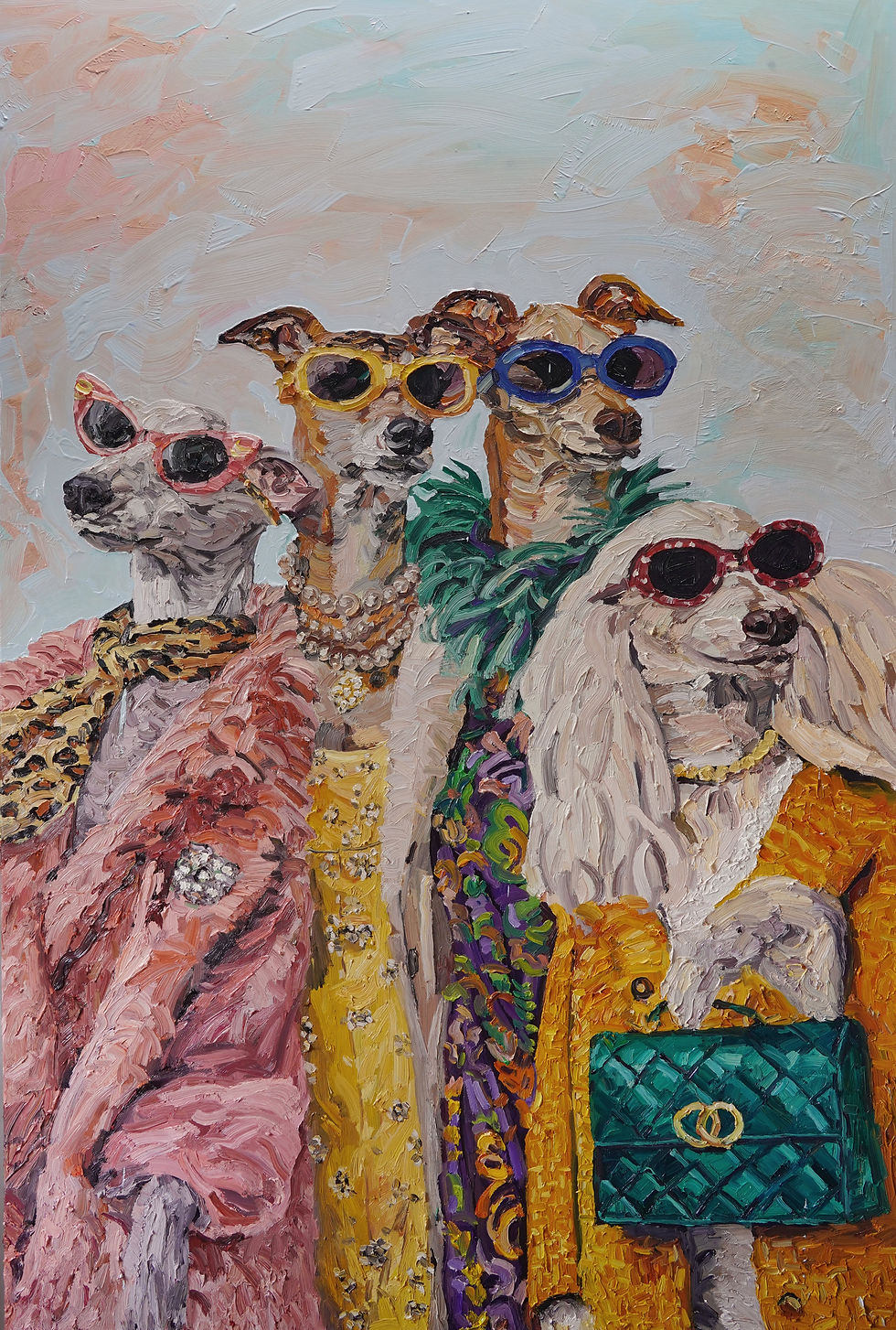
Common Prosperity
2026
Oil on linen
160 × 120 cm
Four elaborately dressed animal figures stand shoulder to shoulder at the front of the composition. Sunglasses, pearls, fur, brightly coloured clothing, and a handbag carrying instantly recognisable visual codes create a language that can be quickly read. The figures appear to possess distinct personalities, yet they are simultaneously incorporated into the same system of image production. Before viewers have time to understand the characters themselves, they have already begun to define their identities through clothing, accessories, and symbols of consumption.
The sunglasses are among the work’s most significant elements. On the one hand, they give the figures an air of confidence, fashionability, and performance; on the other, they conceal their actual gaze. Viewers can observe the characters but cannot determine whether those characters are looking back. Unlike the open, multidirectional exchange established in Mutual Gaze, the possibility of visual reciprocity in Common Prosperity is blocked by dark lenses. The characters’ inner states recede, while external signs become the primary means through which their identities are recognised and classified.
The title introduces an open and subtle semantic tension. “Common” refers not only to the figures’ simultaneous presence within a collective portrait but also to their shared participation in a system of values shaped by images, taste, and consumption. “Prosperity,” meanwhile, no longer describes material circumstances alone. It becomes a visual identity that must be displayed, recognised, and confirmed. When each individual relies on similar symbols to demonstrate uniqueness, difference paradoxically begins to converge into a new form of uniformity.
Tian Hang neither openly celebrates nor ridicules these figures. The pale, luminous background, the group arrangement reminiscent of a fashion editorial, and the gently humorous animal characters give the work an initially light and accessible appearance. At the same time, the artist’s thick, rough handling of paint continually disrupts the polished surfaces associated with consumer imagery. Luxurious clothing and accessories are reduced to visible deposits of pigment, allowing the seduction of the symbol and the physical truth of paint to occupy the same space.
In Tian Hang’s practice, the animal figure serves both as a screen behind which identity can temporarily disappear and as an experimental field through which its construction can be reconsidered. Once specific markers of human identity are removed, the role of external gazes and visual symbols becomes more apparent. In Mutual Gaze, identity emerges through frames, positions, and intersecting acts of looking; in Common Prosperity, it is formed through clothing, consumption, and the collective image. Although the two works appear to describe different situations, they ultimately pose the same question: are we looking at a living being, or at the familiar systems of classification through which we have learned to interpret it?
Tian Hang’s concept of “Eastern Symbolic Expressionism” is not simply a surface-level combination of Eastern imagery and Western Expressionist forms. Its Eastern dimension is more deeply rooted in an attention to vital resonance, or qiyun, the expressive value of empty space, and the relationship between the self and the material world. In his paintings, there is no permanently stable boundary between subject and object, viewer and viewed, reality and image. Colour, material, and symbolic figures do not provide fixed answers; together, they construct a perceptual and spiritual field into which the viewer is invited to enter.
The significance of Tian Hang’s painting lies not only in the recognisability of his animal figures, but in his ability to make them carry an enquiry into contemporary ways of seeing. His works do not instruct viewers how to interpret what lies before them. Instead, they allow the gaze to travel continuously between painting and observer. When the figures begin to return our gaze, what comes under examination is no longer simply the animal, the clothing, or the frame, but the ways in which we look at others and gradually construct ourselves within the countless gazes and images that surround us.