
Between Layers of Colour, Landscape Re-emerges: Light, Time, and Inner Perception in Ya Wang’s Painting

In Ya Wang’s paintings, one seldom encounters a horizon, flower, or urban silhouette that can be identified at a glance. Yet viewers can still sense light moving, the atmosphere shifting, and a strangely familiar landscape slowly emerging from between successive layers of colour.
Rather than reproducing nature directly, Wang transforms reality filtered through memory, emotion, and bodily perception into colour, texture, and rhythm. Nature is no longer presented as a specific location. It becomes an inner experience that can be dismantled and reorganised through painting.
Ya Wang has long worked with oil and acrylic mixed media, exploring the relationships between natural scenery, urban light, everyday experience, and individual states of mind. Her painting does not completely abandon reality, but deliberately weakens the boundaries of recognisable forms. Light, vegetation, architecture, weather, and fragments of daily life enter the canvas only to be dissolved into fields of colour, traces, layers, and changing tonal relationships.
Oil and acrylic introduce two different experiences of time into her work. Oil paint offers weight and thickness, allowing the surface to be repeatedly covered, altered, and reworked. Acrylic dries more quickly and can remain translucent, enabling colour to flow, overlap, or stop abruptly. When the two media meet, the painting holds accumulation and immediacy, control and chance, opacity and transparency within the same surface. Their combination is not merely a technical decision; it becomes a method for processing memory and perception.
In Blaze Glow, red, orange, and flesh-toned pink dominate the composition. Deep reds gather along the lower section and edges, giving the painting visual weight, while white and pale grey break through the warmer layers like light opening fissures within intense heat. No literal flames are depicted, yet the compression, expansion, and fragmentation of colour make burning perceptible as a condition.
The “blaze” of the title arises from the continuous movement of red across the surface rather than from a recognisable image. The “glow” is similarly not a fixed source of illumination. It emerges through covering, scraping, and the renewed exposure of underlying layers. Light appears to originate from within the accumulated colour itself. Red therefore signifies more than passion or intensity; it also carries traces of sedimentation, exhaustion, and passing time.
Compared with the expansive structure of Blaze Glow, Dusk Superposition is organised through a more pronounced horizontal order. Magenta, blue-grey, brown, and off-white overlap like geological strata, suggesting the distant possibility of a horizon, a body of water, or a receding landscape. These impressions never fully stabilise. They remain suspended at the threshold where landscape is about to appear and simultaneously about to disappear.
“Dusk” is not presented as a single moment, but as an unfolding visual process. Colours are denser on the left, where violet and blue create a sense of depth. On the right, paler layers resemble a fading curtain of light, causing the space to become progressively indistinct. “Superposition” describes both the painting’s construction and its underlying idea: what appears before us has been assembled from different moments, emotions, and visual memories.
Chroma Vision shares the warm palette of Blaze Glow, yet its surface is denser and more complex. Red marks are dispersed among ochre, pink, grey, and pale blue. Some pigments descend vertically, while areas of scraping reveal the weave of the canvas beneath. The painting may evoke a weathered wall, a city seen from above, or a collective memory repeatedly written over and partially erased.
None of these associations becomes a definitive answer. The “vision” of the title does not refer to the detailed depiction of visible things, but to the brief appearance of different experiences within colour. Objects are compressed into traces and narrative is broken into strata. The work retains the temperature of reality while refusing to provide it with a fixed outline. Abstraction in Ya Wang’s practice is therefore not an escape from reality, but a reorganisation of visual memory.
In Mountain Flowers in Full Bloom, the dominant palette moves from warm tones towards turquoise, green, and blue. Broad areas of cool colour unfold through horizontal gestures, while deep red marks are scattered across the surface, creating a vivid yet controlled contrast. The painting does not depict mountains or flowers directly, but the red dots, patches, and fluid traces may still suggest petals, reflections, or brief manifestations of life within nature.
Compared with the other works, Mountain Flowers in Full Bloom preserves a greater sense of openness. Greens and blues allow the eye to travel horizontally, while the red marks act like rhythmic accents that repeatedly interrupt the calm of the cooler field. The work does not present nature as simply cheerful or harmonious. It evokes a living condition that contains growth, disturbance, and disappearance at once. “Full bloom” becomes less a description of flowers than a chromatic translation of vital energy.
From the spreading warmth of Blaze Glow and the horizontal accumulation of Dusk Superposition to the dense surface of Chroma Vision and the cooler expansiveness of Mountain Flowers in Full Bloom, Wang continually alters the temperature, density, and direction of her paintings. None of the four works contains a dominant central figure. The viewer’s gaze must move between different layers and marks, entering the time and space produced by colour rather than searching for a single subject.
The gentleness associated with Wang’s painting should not be mistaken for fragility or uncomplicated visual pleasure. Bright colours are repeatedly disrupted by scratches, fractures, and acts of concealment, while calm fields of blue and green retain the tension introduced by red. She does not reduce emotion to a single conclusion. Warmth and force, order and accident, consolation and unease remain active within the same composition.
The titles offer viewers a point of entry without closing down interpretation. Dusk Superposition may be experienced as an evening landscape or as overlapping memory; Mountain Flowers in Full Bloom may refer to nature or to a condition of life. Blaze Glow and Chroma Vision release light and the visible world from specific forms, allowing them to become events occurring within colour.
The central concern of Ya Wang’s painting is therefore not simply the fusion of oil and acrylic, but the transformation of experiences that resist direct description into visible surfaces. Every new layer changes what came before it, while each scrape allows something concealed to reappear. The canvas becomes a place in which time continues to accumulate: new experiences cover earlier memories, yet older traces persistently return through cracks and openings.
Her works do not ask viewers to identify a fixed scene. Instead, they invite us to reorganise our own experiences through colour. Once colour is no longer bound to a specific object, it becomes more than a means of filling form; it becomes the site where light, emotion, and time occur together. It is through this encounter between painted surface and individual perception that landscape begins to emerge again.
Artwork Information
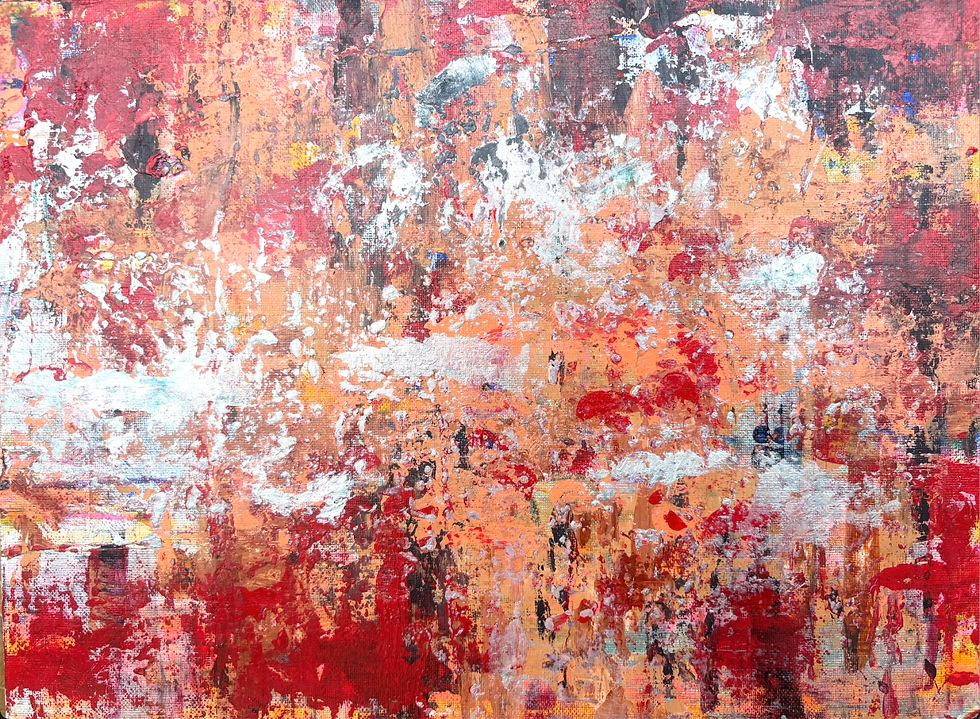
Blaze Glow
60 × 80 cm

Dusk Superposition
50 × 60 cm

Chroma Vision
60 × 80 cm

Mountain Flowers in Full Bloom
40 × 50 cm


