When Landscape No Longer Points to a Place: Material, Color, and Inner Landscapes in Qiuxin Wang’s Jing Series
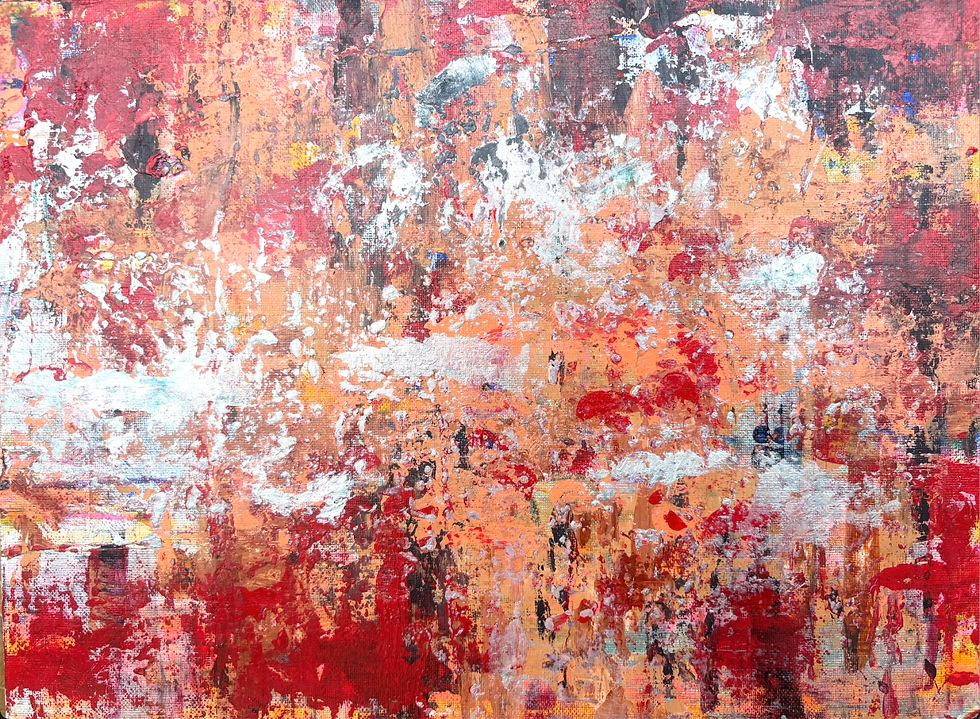
Before Qiuxin Wang’s paintings, what first appears is neither a mountain that can be named nor a river whose course can be followed, but a surface still in the process of becoming. Black, blue, violet, yellow, and silver-gray overlap, while light breaks through gaps, abrasions, and ruptures in the layers of color. Only when the gaze lingers long enough does a landscape begin to emerge, indistinctly, from among these material traces.
This is the point of entry into the Jing series. Rather than offering a natural scene that can be immediately recognized, the works invite viewers to pass through the painted surface and enter a perceptual state suspended between reality, memory, and imagination.
Qiuxin Wang was born in Qingdao, China, in 1989 and began studying art as a child. She currently works in cultural-space design and film and television production, with professional roles spanning design, curating, and production. She is a member of the Qingdao Artists Association. She contributed to the visual identity design and production of the 14th National Student Sports Games and served as a visual identity designer for the “Qingdao Time-Honored Brands” initiative. Her works have also been included in projects such as the 2024 International Art Exhibition at the Grand Palais in Paris and Temperature: Contemporary Art Exhibition at the Louvre in France.
These cross-disciplinary experiences offer another way of understanding her painting. Spatial design has sharpened her attention to structure and scale, while film production has cultivated her sensitivity to rhythm, time, and visual orchestration. Her curatorial experience also encourages her to approach a painting as a field that viewers can enter and inhabit. In her work, colors are not simply released; they behave like actors within a scene, forming relationships through expansion, retreat, concealment, and reappearance.
The Jing series began with Wang’s exploration of how Chinese landscape painting might be expressed through contemporary art. For her, the landscape tradition is not a collection of images waiting to be reproduced, but a visual grammar for organizing the world. Mountains, water, clouds, trees, and rocks need not appear as recognizable motifs. Instead, they can be transformed into structure, movement, breath, growth, and weight, collectively shaping the opening and closure, fullness and emptiness, and rhythm of the composition.
“Jing” therefore refers both to an outwardly visible scene and to a state generated within the mind. Wang’s imagined “grand mountains and waters, great trees and flowers” do not seek to reproduce the scale of nature accurately. Instead, they amplify the emotional intensity produced by our encounter with the world. At times assertive and clamorous, at other times quiet and expansive, these scenes dissolve the boundary between external landscape and internal experience.
Materiality offers another route into the series. Layering, erasure, overpainting, controlled flows, and transitions between matte and luminous areas preserve traces of the time involved in making the work. Wang does not conceal her materials behind a smooth and complete image. Instead, unevenness, rupture, and friction between layers become integral parts of the painting. The viewer cannot grasp the entire image at once, but must gradually discern its spatial relationships as the gaze moves across the surface.

Jing: Xiaguang Liucai (Flowing Colors of the Afterglow)
2024
Mixed-media painting
60 × 60 cm
In Jing: Xiaguang Liucai (Flowing Colors of the Afterglow), deep black and blue-gray areas form an almost enclosed underlying structure. A luminous blue unfolds across the upper field, while white and pale gray descend through the center, passing between dark, rock-like forms. Flecks of fluorescent yellow-green appear throughout, resembling distant points of light or signs of life briefly revealed from within the material. Vertical black lines and irregular edges further interrupt the continuity of the composition, making the landscape appear segmented, covered over, and reassembled.
The “afterglow” of the title is not presented as a specific sunset. Light is not an object being depicted, but a force acting within the painting. It opens the dark structure and is immediately surrounded by darkness; it makes space visible while simultaneously revealing its fractures. The painting’s stillness is therefore not naturally given, but constructed through the balance of color and structure. Beneath its apparent calm, a lingering tension remains.
Jing: Fanhua (Prosperity) directs this energy toward a more expansive state. Black and white establish broad intervals of pause, while pink, orange, and violet gather and blossom on the left. An almost acidic yellow suddenly flares in the upper-right area, disrupting the existing visual balance. The colors are organized through echoes, repetitions, and interruptions, like a musical movement with its own internal rhythm.

Jing: Fanhua (Prosperity)
2024
Mixed-media painting
60 × 60 cm
Yet Jing: Fanhua is not an uncontrolled explosion of color. Dark areas repeatedly interrupt the outward expansion of the pigments, while white spaces allow the denser layers to breathe. “Prosperity” therefore signifies more than visual abundance; it becomes a metaphor for a condition of life. Flowers, mountains, rivers, and minute living presences seem to awaken at once, yet all remain subject to the passage of time. The more radiant something becomes, the more strongly we sense that it cannot be held forever.
The two works present two conditions of the same present. Jing: Xiaguang Liucai embodies a stillness that must be repeatedly constructed and that always contains the possibility of fracture. Jing: Fanhua, by contrast, presents a rhythmic vitality that retains an awareness of time within its joy. One allows light to emerge slowly from darkness; the other restrains color before it reaches complete saturation. Both resist being grasped in a single glance.
Wang connects her experience of color with a female perspective. She has drawn inspiration from women artists whose work combines vivid and delicate color with boldness and determination. Yet the “female power” in her paintings does not depend on a fixed ideal of softness. Diffuse, supple washes coexist with hard black planes, while luminous blocks of color are held within controlled structures.
Tenderness and resolve, expansion and self-possession no longer cancel each other out. Their coexistence gives the work its distinctly contemporary force.
Wang’s transformation of the Chinese landscape tradition is therefore neither the insertion of Eastern symbols into abstract painting nor an attempt to produce nostalgia through tradition. What she carries forward is landscape painting’s way of understanding space and life: allowing fullness and emptiness to generate one another, letting breath circulate between colors, and turning viewing into a process that requires time.
The value of Qiuxin Wang’s painting does not lie in whether the viewer can identify a mountain, a cloud, or a river. It lies in her ability to make “landscape” become an unfolding experience once again. When the viewer pauses among color, darkness, and emptiness, landscape no longer belongs to a distant natural world. It is reconstructed within the mind at the very moment of seeing.