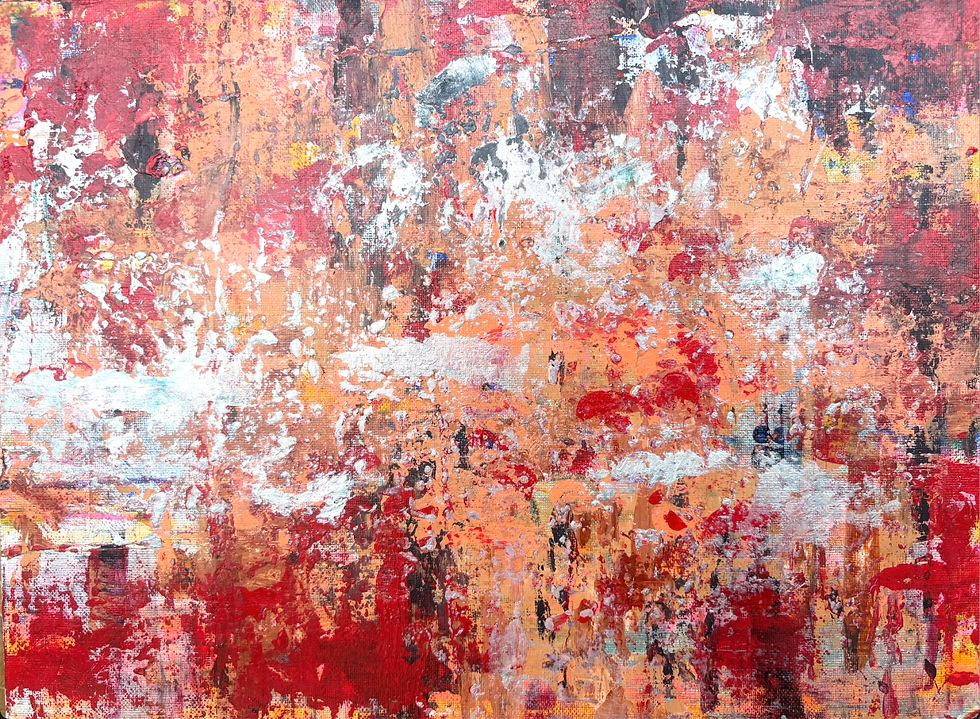
Emission of Presence: Chaos and Structure in the Art of Vladimir Tomić
I. Introduction and Academic Context

Vladimir Tomić (b. 1986) is a contemporary visual artist and academic whose practice examines the boundary between chaotic, unstructured form and conscious presence. Based in Trebinje, Bosnia and Herzegovina, Tomić completed his Bachelor of Fine Arts and Master of Fine Arts degrees at the Academy of Fine Arts in Trebinje, University of East Sarajevo. He currently serves as a Senior Assistant in the Department of Painting, Drawing, Photography, New Media, and Installation at the same institution.
Tomić’s dual role as an active studio artist and an academic researcher drives a practice characterized by technical discipline and conceptual depth. Over his career, he has developed a cohesive body of work exhibited across the Balkan region and internationally
II. The Visual Philosophy: Mapping the Unconscious
Tomić’s portfolio represents a deliberate visual exploration of the psychology of the unconscious, focusing primarily on the subject’s relationship to the process of becoming conscious. The central theme running through his practice is the extraction of elements from the primordial chaos of the unconscious and their subsequent structuring into coherent, emitting entities. This process is viewed not merely as an act of creation, but as a complex confrontation with the unpredictable contents of inner life, their channeling, and, finally, their framing into a clear formal structure.
Within this framework, each artwork is positioned as a mirror of chaos. The constructed frame functions as much more than a physical boundary of the work; it is a space of active interaction where the elements within it constantly communicate. This structure serves as a field for the viewer's own projections, but it simultaneously functions a reflection of the creating subject. The artist stands before his own work as if before a mirror, confronting fragments of the self that have traveled the path from an abstract impulse to a materialized form.
The path to the unconscious mapped by these works is neither linear nor purely conceptual. It is defined by cyclical processes of losing, searching, fracturing, and returning. The process of connecting two distinct realities—the inner, chaotic universe and the outer, framed environment—inevitably leaves a record on the surface. Within the structure of the artwork, these traces manifest as scars of lived experience. They represent the transition points from one reality to another, serving as testaments to the continuous effort required to make the intangible present.
Ultimately, the construction of these works relies on a threefold process: releasing internal pressures, actively searching for meaning, and framing the internal content. Each piece carries the weight of lived experience and offers a promise of wholeness. Individual elements of chaos, previously scattered and hidden within the infinity of existence, here become the fundamental building blocks of the self. Through a deliberate interplay of combination, association, and direct confrontation, these fragments form a new, conscious structure. Here, the artistic act ceases to be merely aesthetic and becomes profoundly existential—a tool by which parts of the self are extracted from the chaos of existence and integrated within the frame of consciousness.
III. Parallel Tracks: Studio Intuition and Theoretical Research
A defining element of Tomić’s methodology is the deliberate autonomy maintained between his studio practice and his theoretical writing. He does not create artwork to merely illustrate his texts, nor does he write theory as a literal guide for the studio. The studio remains an arena for intuitive, tactile experimentation with medium and surface, while his writing operates as a scholarly investigation into the phenomenology of the aesthetic mark.
While independent, these two tracks constantly cross-pollinate. Material discoveries on the paper inform his academic writing, while his theoretical research into the "Emission of Presence" provides the conceptual framework needed to analyze how structural order emerges from raw chaos. This research forms the basis of his manuscript, Phenomenology of framing and high resolution of esthetic presence: Fingerprint in Chaos.
IV. Large-Scale Work: Material and Structure
On a macro scale, Tomić's studio functions as a space where he addresses the physical weight and texture of raw materials. In monumental works such as The Great Dark Queen (2021) and The Endless (2021), the canvas serves as a site for structural transformation.

The Great Dark Queen (2021): This large-scale mixed-media work (150 x 200 cm) features dense, highly textured, and eruptive layers of paint dominated by a pale, circular form that emerges from a dark field.

The Endless (2021): Spanning the same dimensions, this piece features prominent vertical slashes and dripping paint, out of which a singular, root-like organic shape rises from a white foundation.
On this scale, the search for order is a direct, somatic engagement with materials.

The structural culmination of this large-scale methodology is Wunjo (2019–2021). Measuring 193 x 135 x 10 cm, the work consists of a massive, three-dimensional wooden grid holding hundreds of individual, gestural drawings. Each tiny compartment contains a unique, energetic mark, yet they are locked within a rigid, uncompromising matrix. Wunjo functions as a visual manifestation of Tomić’s core thesis: it establishes a systematic structural frame that organizes a wide variety of chaotic impulses without stripping them of their initial energy.
V. Small-Scale Work: Contained Coordinates
In contrast to the heavy textures of his large-scale canvases, Tomić’s small-format works on paper and cardboard operate as precise, quiet psychological diagrams. Where the large works immerse the viewer in the physical process of mark-making, these smaller pieces distill that energy into a clear visual shorthand.

Self (2025): This drawing (21.6 x 18.6 cm) utilizes a vertical stack of three distinct visual elements to construct a glyph of balance. A textured cloud of pastel marks on top is anchored by a solid, horizontal bar in the center, which rests on a clean turquoise crescent at the bottom. The composition relies on Gestalt principles, demonstrating how the human eye instinctively finds equilibrium within a framed space.

Ø (2025): In this work (22.2 x 20 cm), a dark, gestural crescent forms a protective boundary around a dense nucleus of sharp, needle-like black strokes, punctuated by a single red mark. Here, the empty space functions as a deliberate vessel of containment, gathering highly charged marks into a focused area.
VI. Focus Piece: Journey-elements

The artwork selected for the III Edition of the MEDUSA, LA GORGONE Art Prize in Livorno, Journey-elements (2026), bridges these two different scales. Created on a compact 14.8 x 14.8 cm square of cardboard, the work retains the dense materiality of his large canvases but contains it within the strict boundaries of his small-scale diagrams.
A dominant, sharp wedge of bright blue paint sweeps across the upper center of the composition. This mark serves as a literal "fingerprint" of consciousness—a clear trace of human presence cutting through a textured field of white washes and underlying color. Visible beneath the paint layers are grid-like incisions scratched directly into the cardboard, which establish the coordinate lines of a journey. By balancing this bold blue gesture against a raw, scraped surface, Journey-elements captures the exact threshold where material chaos transitions into a clear, aesthetic signal.
VII. Conclusion
Whether executing complex textures on massive canvases or placing a single mark within a small crescent on paper, Vladimir Tomić focuses on the human need for orientation. By maintaining his studio work as an intuitive process and his academic writing as an analytical pursuit, he has developed a balanced, rigorous body of work. His art does not merely present a finished form; it captures the moment form emerges from an empty field, leaving a distinct human footprint on the structure of the work.
Official Website: https://vladimirtomic.weebly.com/
Professional Email: pravivladimirtomic@yahoo.com