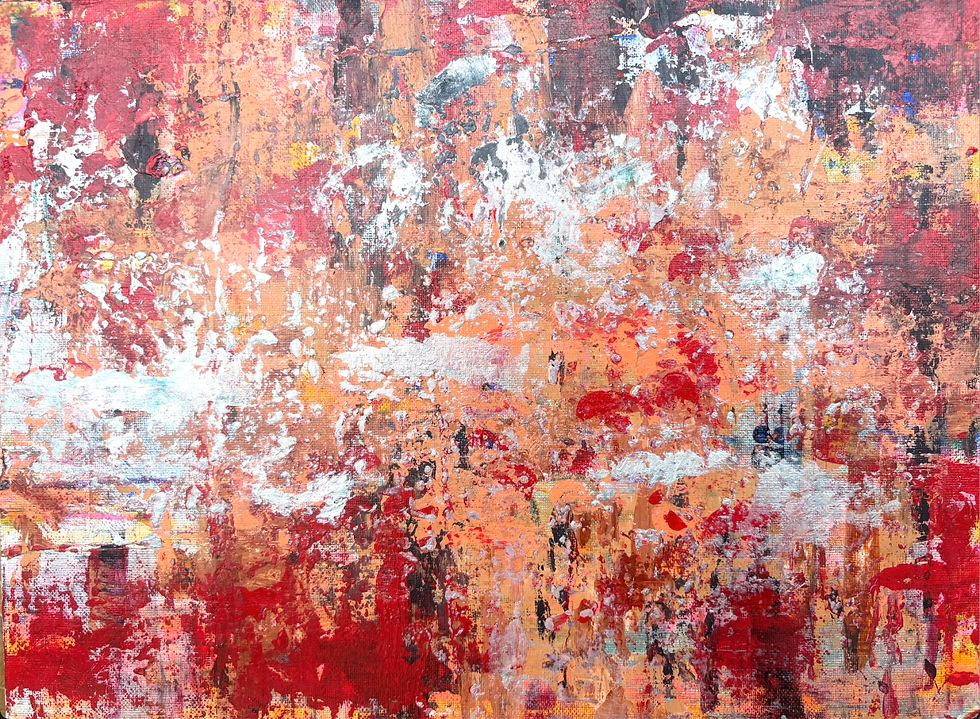
Chun Fan: Rewriting Abstraction through the Stream-of-Consciousness School, Opening a Spiritual Fissure in the “World of Form and Emptiness”

In a contemporary art context increasingly shaped by “speed, symbols, and visibility,” Chun Fan has chosen a more difficult yet more enduring path: to draw painting back into the realm of the spirit—where color is no longer merely a visual stimulus, but a means of inward arrival.
Born in Guangdong, China, raised in Hong Kong, and now a Canadian artist, Chun Fan holds positions in multiple academic and artistic organizations, including Chairman of the Board of the New Asia Institute in Hong Kong, Vice President of the Hong Kong International Youth Artists Association, Vice President of the Hong Kong Zhaoming Art Society, and member of the Hong Kong Artists Association. He also serves as Director of the Hongzhi Zhongji Hakka Culture Museum in Heyuan, and Chairman of the School Board and Artistic Director of Nankai Experimental School in Heyuan.
In his early artistic formation, he was deeply influenced by the conceptual framework of Western modern abstract expressionist master Mark Rothko, while also being shaped by the traditions of Zen painting and Buddhist thought. In his practice, these two spiritual lineages—Eastern and Western—are not juxtaposed as collage-like references; rather, they are translated toward a single shared aim: to construct, within the pictorial field, a spiritual world that transcends the limits of materiality.
Chun Fan studied under the renowned contemporary painter Huang Peijiang of Hong Kong and Macau, receiving systematic training in oil painting, watercolor, ink painting, charcoal drawing, and calligraphy. This mode of “horizontal absorption” did not ultimately lead him toward a virtuoso layering of formal techniques. Instead, it reinforced his commitment to returning to the most fundamental efficacy of painting itself: how color, brushwork, and space can directly activate emotion and spiritual experience.
By combining diverse painterly techniques with the spirit of Expressionism, Chun Fan proposed and put into practice the Stream-of-Consciousness School. Here, “stream of consciousness” does not refer to literary narration; it functions more as a working method: completing composition through immediate emotion, intuition, and bodily rhythm, allowing the image to manifest the “truth, goodness, and beauty” of the human world while interpreting the Eastern aesthetic conception of the “world of form and emptiness.”
He has also made a strikingly manifesto-like statement: “My paintings should still move viewers five hundred years from now.” The significance of this remark lies not in its grandness, but in the long-term standard it establishes: a work must possess the spiritual durability to penetrate the noise of its age.
As part of his ongoing international exchange trajectory, Chun Fan’s works have also entered the context of major national public art institutions. On October 11, 2024, the exhibition “Vietnam–Hong Kong: Art Excellence Exhibition” opened at the Vietnam National Museum of Fine Arts in Hanoi, presenting a cross-cultural artistic dialogue between Vietnam and Hong Kong.

The two colored-ink works presented in this exhibition, Treasure in Water (2024) and Chromatic Illusion (2025), represent two more distinctly contemporary facets of Chun Fan’s ongoing path of “spiritual spatial construction”: one points toward the awakening of value in the depths of the subconscious, while the other responds to the need for spiritual self-rescue in an age of sensory overload.

Treasure in Water
Dimensions: 70 × 137 cm
Medium: Colored ink
Treasure in Water transforms a dark body of water into a metaphor for the subconscious, while fragments of bright color appear like long-buried glimmers of light. The creative process repeatedly tests the layers between “density and transparency,” like searching in darkness for something still capable of shining. This is both the construction of the image and an inward act of self-reminding: value and energy have not disappeared; they have simply been hidden more deeply.

Chromatic Illusion
Dimensions: 20 × 50 cm
Medium: Colored ink
Chromatic Illusion begins from the experience of “everyday visual fatigue.” The collision of warm and cool color blocks corresponds to the swaying and dazed sensation that follows overstimulation. The true key gesture of the work lies in the repeated cycle of “adding color—washing it down,” in order to find an image density that can still “breathe.” As the world grows increasingly noisy, the artist seeks to open a fissure for the spirit, allowing attention to return to the inner order of the self.